
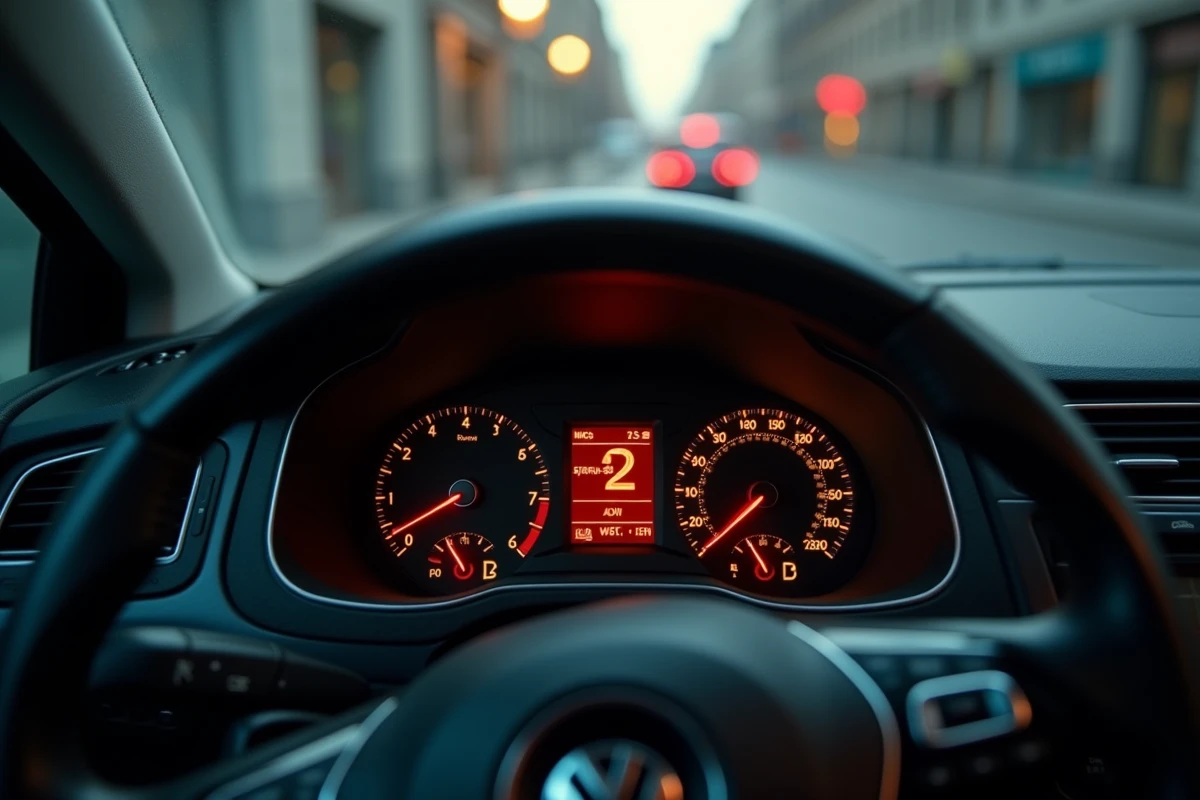
The engine warning light on your Volkswagen Polo 5 has just turned on on the dashboard. This small icon in the shape of a stylized engine indicates a discrepancy detected by the vehicle’s electronic control unit. Depending on whether it remains steady or starts to blink, the course of action differs significantly.
Steady or blinking engine light on Polo 5: two distinct levels of severity
The control unit of the Polo 5 continuously monitors dozens of sensors related to fuel injection, air intake, temperature, and emissions. As soon as a value goes outside the expected range, it records a fault code and turns on the warning light.
A steady engine light indicates a non-critical fault. You can usually continue driving at a moderate speed to reach a garage. The failure does not immediately damage the engine, but it should not be ignored for several weeks.
A blinking engine light while driving, on the other hand, corresponds to a more serious situation. Volkswagen specifies in its recent after-sales documentation that blinking indicates a risk of damage to the catalyst or particulate filter. The official instruction is then to significantly reduce speed and stop as soon as possible. To better understand the meaning of the engine light on Polo 5, this first visual criterion must be taken into account before any other analysis.
EGR valve and mass airflow sensor: common causes on TDI engines of Polo 5
Do you own a Polo 5 diesel? The EGR valve is among the first components to suspect. Its role is to reintroduce a portion of the exhaust gases into the intake to lower combustion temperature and limit nitrogen oxides.
Over time, this valve becomes clogged. The control unit then detects an abnormal recirculation flow and triggers the engine light. Since the software reprogramming post-Dieselgate, several technical bulletins from Volkswagen published between 2021 and 2024 mention an increased sensitivity of the control unit to exhaust gas recirculation faults. The light comes on earlier than before the update, in order to limit actual NOx emissions.
The mass airflow sensor (also known as the air mass sensor) is another component often at fault. If it transmits a distorted measurement, the air-fuel mixture becomes incorrect. The associated symptoms are telling: loss of power during acceleration, smoke from the exhaust, unstable idle.
Concrete symptoms to observe while driving
Before heading to the workshop, note what you feel at the wheel. This information helps the mechanic to guide their diagnosis.
- A noticeable loss of power beyond a certain RPM may indicate that the control unit has entered a degraded mode, intentionally limiting the engine to protect it.
- Stuttering or misfiring at low RPMs points more towards an injection or ignition coil problem (on gasoline versions).
- An unusual increase in fuel consumption, without changes in route or driving style, suggests a faulty sensor that distorts the mixture dosage.
- A stronger than usual smell of sulfur or exhaust may signal an issue with the pollution control system.
OBD diagnosis on Polo 5: what the diagnostic tool reveals
The engine light does not provide any precise indication by itself. To identify the fault, the fault code recorded in the control unit must be read. This is the role of the OBD (On-Board Diagnostics) port, usually located under the dashboard on the driver’s side of the Polo 5.
A basic OBD reader, available for a few dozen euros, is sufficient to extract the fault code (in a format like P0XXX). This code points to the system or sensor involved. For example, a code related to the EGR circuit does not indicate the same intervention as a code related to the lambda sensor.
Clearing the fault code without repairing the cause is pointless. The light will come back on as soon as the control unit detects the anomaly again, sometimes after just a few kilometers. Some drivers clear the code before the technical inspection hoping to pass the test, but this strategy no longer works.
Technical inspection and pollution fault codes
Since July 2022, the French technical inspection includes a mandatory reading of OBD fault codes on Euro 5 and Euro 6 diesel vehicles. The majority of Polo 5s on the road belong to these categories. An engine light illuminated for an unresolved pollution fault, even without visible smoke or noticeable power loss, can lead to a re-inspection.
In other words, driving with an illuminated engine light without addressing it exposes you to a refusal during the next technical inspection, in addition to the mechanical risk.

What to do when the engine light comes on in your Polo 5
The reaction depends on the behavior of the light and the symptoms felt.
If the light is steady and the car is running normally, make an appointment at the workshop in the following days. Avoid long highway trips and heavy engine loads in the meantime.
If the light is blinking, immediately reduce your speed. Do not increase the RPM. Find a safe place to stop and have the vehicle towed if the blinking persists after a restart.
- Check the fuel cap: a poorly closed cap can cause a pressure fault in the evaporation circuit and turn on the light. This is the simplest cause to eliminate.
- Check the engine oil level with the dipstick. A very low level can trigger additional alerts.
- Note the exact mileage at the time of the light turning on and the driving conditions (cold start, uphill, highway). These details facilitate diagnosis in the workshop.
A diagnosis with an OBD tool is essential to accurately identify the source of the problem. Without this reading, even an experienced mechanic can only make assumptions. On an aging Polo 5, the cost of this reading is more than offset by the time saved on diagnosis and the peace of mind of a successful technical inspection.