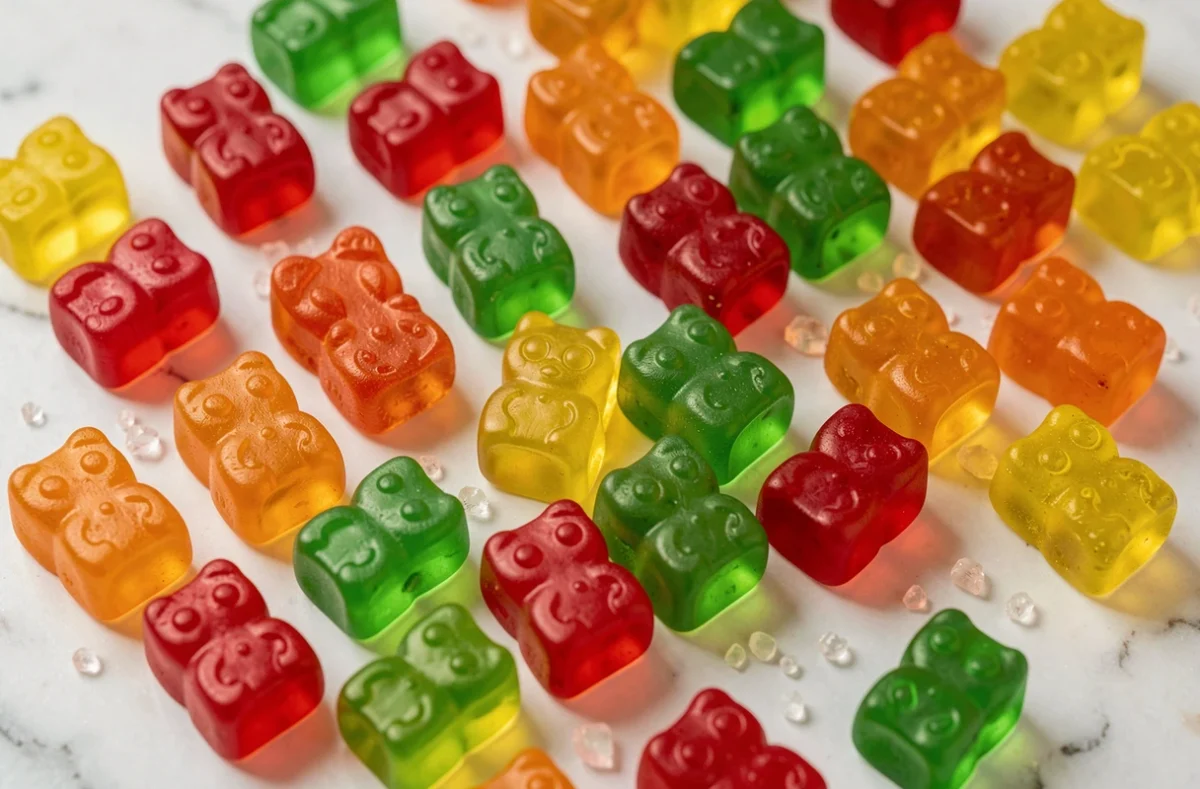
When you open a bag of Gold Bears or Dragibus, the candy has already gone through several precise manufacturing steps. Behind the texture, color, and taste of each Haribo confectionery lies an industrial process that blends ancient know-how with modern technology. Understanding these steps also reveals why some candies are chewy and others are elastic, and what really happens in the brand’s French and European factories.
Gelatin at the heart of Haribo gummy candies
Have you ever noticed that Gold Bears bounce slightly when placed on a table? This elasticity comes from a key ingredient: gelatin. It is what gives gummy candies their firm yet flexible texture.
Gelatin is an animal-derived protein obtained from collagen. It is mixed with sugar, glucose syrup, and water, then heated to form a thick liquid. This liquid is then poured into corn starch molds, which give the candies their characteristic shapes (bears, bottles, crocodiles).
The origin of gelatin is not always visible on the packaging. The European INCO regulation requires it to be mentioned in the ingredient list but does not require its animal origin to be specified. A consumer wishing to avoid pork gelatin cannot always rely solely on reading the label.
To find out where Haribo candies are made and which ingredients vary by site, one must dig deeper than the package.
Corn starch molds and cooking: the technical process of gummies
Molding in corn starch is the least known step to the general public, yet it is the most decisive for the quality of the candy. Here’s how it works in practice.
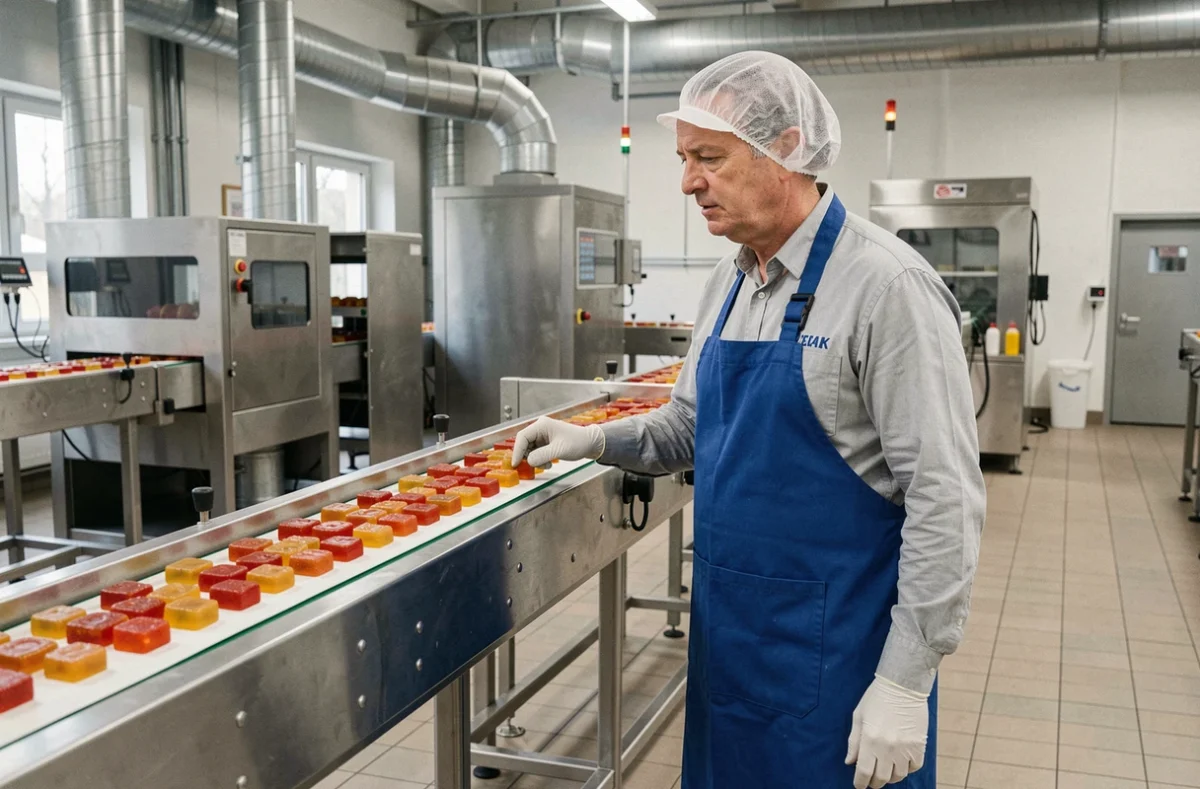
Trays filled with compacted corn starch pass under stamps that imprint the hollow shapes. The hot gelatin mixture is then poured into these molds. The starch serves both as a mold and a moisture absorber: it gradually removes water from the candy during the drying phase, which lasts several hours in drying ovens.
After drying, the candies are unmolded, the starch is recovered, and reused. The confections then pass through rotating drums where they receive a thin layer of beeswax or carnauba wax. This polishing gives them their shiny appearance and prevents the candies from sticking together in the bag.
- The base mixture (gelatin, sugar, glucose syrup, water) is cooked at high temperature before being flavored and colored.
- Pouring into the starch molds determines the final shape and density of the candy.
- The drying in the drying oven controls the moisture content, and thus the texture: the longer the drying, the firmer the candy.
- The polishing in the rotating drum applies a protective layer that ensures appearance and preservation.
Licorice, marshmallow, chewing gum: distinct processes for each range
Not all Haribo candies follow the same path. Licorice, marshmallow, and chewing gum each have a specific manufacturing process.
Licorice candies
The base is an extract of licorice root, mixed with flour, sugar, and a binder. The dough is extruded, meaning it is pushed through molds that give it its shape (laces, rolls, tablets). The cooking and drying are different from those of gummies: licorice requires a lower working temperature and a longer resting time.
Marshmallows
Haribo marshmallows rely on aeration: air is incorporated into a mixture of sugar, glucose syrup, and gelatin. It is this trapped air that gives marshmallows their lightness. The mixture is then extruded or poured, and then dried at low temperature to maintain its fluffy texture.
Chewing gum
Maoam-type candies use a base of sugar, glucose syrup, and vegetable fats. The dough is mechanically worked to achieve an elastic and resilient texture, then cut and individually wrapped.
Haribo factories in France and Europe: Uzès at the center of the strategy
The historic Haribo production site in France is located in Uzès, in the Gard region. This is where Dragibus and part of the licorice candies are made. This site is not frozen in time: Haribo has announced a project to rebuild and expand the factory.
This project aims to increase production capacity and reduce energy consumption at the site. The company is integrating this modernization into a broader strategy that concerns several of its factories in Europe.
From a logistical and environmental standpoint, Haribo states that a significant portion of the electricity used for its production is covered by renewable origin guarantees. The use of BioCNG (a fuel derived from organic waste) and rail transport for certain flows is part of the company’s statements regarding its industrial footprint.
The same candy name, recipes that vary by country
Did you think a bag of Gold Bears purchased in Germany is identical to one purchased in France? Recipes can vary from country to country. Local preferences in taste, texture, and color influence the composition.
A German Gold Bear does not have exactly the same flavor as a French Gold Bear. The dosages of flavors, the colorants used, and sometimes even the source of gelatin differ by market. Each European factory adapts its production lines to local consumption habits.
This variability is rarely visible to the consumer, but it explains why travelers sometimes find a different taste in Haribo candies purchased abroad. It is not a matter of freshness, but rather of regional formulation.
The manufacturing process of Haribo candies combines ancient techniques (starch molding, licorice extrusion) with modern industrial choices (aeration, automated polishing, energy management). The Uzès site remains a pillar of French production, and its expansion confirms that candy manufacturing in France remains a strategic focus for the brand.